

Last Updated: November 7, 2026
Quick Summary
To choose unisex leisurewear for all body types, measure your chest, waist, hips and inseam once, then compare those numbers to the brand's garment size chart rather than the letter label. Buy to the larger size at the chest or hip and adjust the waist, and check the shoulder, chest, waistband and length on every piece.
- A unisex clothing size guide lists chest, waist, hip and length with no separate men's or women's block.
- Measuring yourself for clothes takes about five minutes and one soft tape.
- If your chest and hip land in different sizes, buy to the larger one and adjust the waist.
- Check four points on every piece: shoulder, chest, waistband and length.
- Wash and dry a piece once before hemming, because crepe can shift slightly.
Table of Contents
- Why Unisex Leisurewear Works for Every Body
- The Unisex Clothing Size Guide: Reading Measurements That Matter
- How to Measure Yourself for Clothes: A Step-by-Step Method
- Finding Size-Inclusive Clothing That Actually Fits
- Fit Adjustments for Specific Leisurewear Garments
- How to Style Unisex Clothing for Balance and Comfort
- Fabric Performance and Care: What Keeps Leisurewear Looking Good
- Shop the Afroleisurewear Collection with Confidence
- Frequently Asked Questions
Why Unisex Leisurewear Works for Every Body
Unisex leisurewear is clothing designed with a shared fit rather than separate men's and women's patterns, so one piece can work across many body shapes. For context on the rise of Afro leisurewear that makes unisex pieces relevant, read our article.
The appeal is simple. A shared fit removes the guesswork of shopping two different size charts. It also suits bodies that sit between conventional categories.
Here is the honest part most guides skip: unisex does not mean one-size-fits-nobody. It means the garment is cut with room to move, then adjusted through fabric, waistband and length. Get those three right and the fit follows.
Below, we show you exactly how to read a unisex size chart, measure yourself once, and adjust any leisurewear piece so it sits properly.
The Unisex Clothing Size Guide: Reading Measurements That Matter
A unisex clothing size guide works differently from a gendered one. It usually lists chest, waist, hip and length for each size, with no separate men's or women's block. That means the numbers, not the label, decide your fit.
Four measurements do most of the work:
- Chest or bust: the fullest point, tape level and snug.
- Waist: the natural crease when you bend sideways.
- Hips: the widest point, usually around the seat.
- Inseam: from crotch to ankle bone.
A common mistake is picking a size by the letter alone. Two brands can both label something "Medium" and differ by several centimetres. Always compare your numbers to the chart.
Watch out: if your chest and hip land in different sizes, buy to the larger one and adjust the waist. Sizing down to fit one area is how co-ords end up tight across the shoulders.
How to Measure Yourself for Clothes: A Step-by-Step Method
Learning how to measure yourself for clothes takes about five minutes and one soft tape. Do it once, write the numbers down, and you never guess again.
- Stand tall and relaxed. Don't suck in or puff out.
- Measure your chest. Wrap the tape around the fullest part, level at the back.
- Find your waist. Bend sideways; the crease is your natural waist.
- Measure your hips. Tape around the widest point of your seat.
- Check the inseam. Measure a pair of trousers that already fit, crotch seam to hem.
- Record everything. Keep the note on your phone for online shopping.
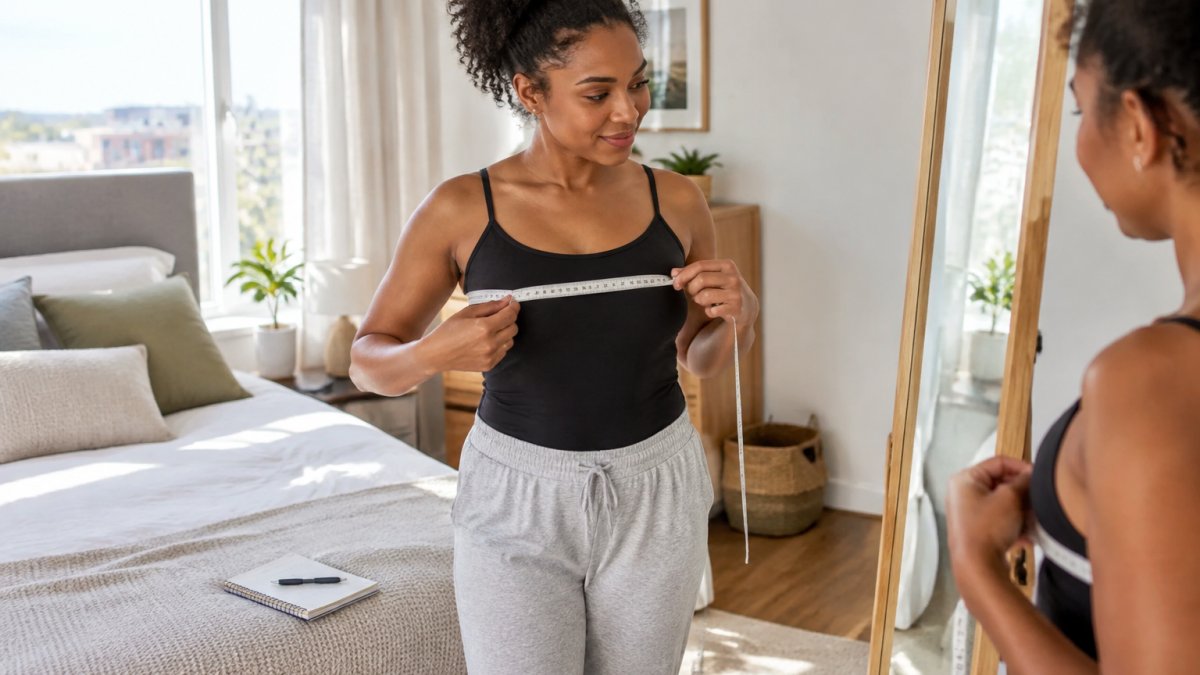
A second person helps for the back measurements, but you can manage alone with a mirror. Recheck the tape is flat, not twisted.
If your numbers fall between two sizes, size up for a relaxed fit and size down only if you want a closer cut.
Measuring yourself takes about five minutes and one soft tape, here is the order to do it in.
| Step | What to do |
|---|---|
| 1 | Stand tall and relaxed, without sucking in or puffing out |
| 2 | Measure chest at the fullest part, tape level at the back |
| 3 | Find waist by bending sideways; the crease is your natural waist |
| 4 | Measure hips around the widest point of your seat |
| 5 | Check inseam on trousers that already fit, crotch seam to hem |
| 6 | Record everything and keep the note on your phone |
Finding Size-Inclusive Clothing That Actually Fits
Size-inclusive clothing is a claim, so treat it like one. A brand that genuinely caters to a broad range of bodies publishes full garment measurements, not just body measurements. Ask for the flat-lay numbers: chest width, waist, hip and length for each size.
Here is how to check a brand before you buy:
- Does the size chart list garment measurements, not only body ones?
- Are larger sizes cut from the same pattern, or just scaled up?
- Do the product photos show the piece on different body shapes?
- Is the returns policy clear if the fit is wrong?
Vanity sizing relabels a smaller garment as a bigger size. Real inclusion shows the tape numbers.
For a deeper method, our guide on how to verify size inclusive clothing walks through the checks step by step. And if you want a shortlist, see our roundup of the best size inclusive African print brands to shop from.
Fit Adjustments for Specific Leisurewear Garments
Fit adjustments for leisurewear come down to the garment type. A jogger set and a wide-leg co-ord need different tweaks, even in the same size. The aim is to check four points on every piece: shoulder, chest, waistband and length. If those sit right, the rest of the fit usually follows.
Hoodies and sweatshirts: the shoulder seam should land at your natural shoulder point, not hang past it. Check the chest width against a hoodie you already own by laying both flat and measuring pit to pit.
Joggers and tapered trousers: the elasticated waist and cuffs do most of the work. If the waist gapes at the back, a quick tuck at the centre-back seam fixes it without altering the front.
T-shirts and relaxed tops: compare the chest width and body length with a tee you like. A unisex tee often has a longer body and a straighter cut than a fitted women's style, so if you are short in the torso, check the length before buying or plan to tuck it.
Shorts: check the inseam and the leg opening. A 15 cm inseam sits mid-thigh on most adults; a 20 cm inseam gives more coverage and reduces ride-up. If the waistband is elasticated, make sure it sits flat when you sit down, not rolled over.
Loungewear sets and wide-leg trousers: the slit or side seam gives movement and stops the leg catching. Hem them to your shoe height, not to the model's, and check the waistband depth: a deeper waistband distributes pressure better if you are sitting for long periods.
Drawstring trousers: the drawstring waist adjusts to your shape, so these suit bodies between sizes well. Tie the drawstring before you check the length, because cinching the waist can lift the hem by a centimetre or two.
A common mistake is hemming before washing. Wash and dry the piece once, then adjust, because crepe can shift slightly. If you are between sizes, buy to the larger measurement at the chest or hip and adjust the waist, rather than sizing down and fighting the shoulders.
How to Style Unisex Clothing for Balance and Comfort
Styling unisex clothing is about visual balance, not hiding your shape. The goal is proportion: pair volume with structure so the outfit reads as intentional.
Try these combinations:
- Volume on the bottom, fitted on top. Wide-leg trousers with a close-fitting tee.
- Volume on top, simplified below. An oversized jacket with tapered joggers.
- One focal point. Let the Ankara print lead; keep everything else plain.
- Break up the set. Wear the jacket with jeans, or the trousers with a plain top.
A belt can add shape at the waist if a co-ord feels boxy. Colour and pattern do the rest: a bold print draws the eye and evens out proportions.
For a closer look at balancing gender-neutral pieces against traditional silhouettes, read our style guide on gender neutral fashion versus traditional clothing.
Fabric Performance and Care: What Keeps Leisurewear Looking Good
Fabric performance decides whether a piece keeps its drape and colour. Most guides stop at "choose breathable fabric"; the useful question is how a fabric behaves across a range of bodies and activities. Compare fabrics on five points: stretch, weight, breathability, opacity and shrinkage.
Stretch and recovery: knits stretch with you and recover their shape; wovens hold their shape but give less.
Weight and drape: lightweight fabrics drape and feel cool but can cling or show outlines; mid-weight fabrics hold a cleaner line and are more forgiving across the chest and hip. Crepe is lightweight and drapes well, which suits a range of body types. Heavier sweatshirting adds warmth and structure but can feel bulky on a smaller frame.
Breathability: natural fibres and open weaves let heat escape; dense synthetic fleece traps it. If you run warm or wear leisurewear for movement, look for cotton-rich or viscose-rich blends and avoid fully synthetic linings against the skin.
Opacity: lighter colours and thinner fabrics can become see-through when stretched over the hip or chest. Hold the fabric up to the light before buying, or choose a mid-weight or darker colour if opacity matters to you.
Shrinkage: cotton and viscose can shrink on the first wash, especially in hot water. Wash cold, by hand or on a gentle cycle, and do not tumble dry. Iron on low heat, inside out, to protect the print. Do not tumble dry, and wash cold to care for the print.
Match the fabric to the job: soft knits for lounging, crepe and woven sets for outings, and mid-weight sweatshirting for cooler days. If you are choosing between two pieces, pick the one whose fibre mix and weight suit how you will actually wear it, not just how it looks on the model.
Shop the Afroleisurewear Collection with Confidence
Comfortable, size-inclusive leisurewear should not ask you to compromise. Our Unisex Ankara Crepe Jogger Co-Ord Set pairs a bomber jacket with tapered joggers in a unisex fit, with an elasticated waist and cuffs, at £29.99. The Unisex Ankara Crepe Co-Ord Set offers a matching jacket and wide-leg trousers, also £29.99. Both are made from premium crepe with Ankara print.
Ready to build a wardrobe that celebrates your heritage and fits properly? Start with the Unisex Ankara Crepe Jogger Co-Ord Set and measure once before you order. Get started with Afroleisurewear and wear your culture with comfort and confidence.

The challenge is finding leisurewear that fits your body and celebrates your heritage at once. Afroleisurewear makes that easy with size-inclusive unisex designs, authentic Ankara print accents, and limited-edition drops from £5 to £50. Get started with Afroleisurewear and build a wardrobe that fits and feels like you.
Frequently Asked Questions
How should unisex clothing fit?
Unisex clothing is cut to fit a range of bodies rather than a single gender, so it usually has a straighter, more relaxed shape through the shoulders and waist. It should feel comfortable without pulling across the chest or hips. Check the size chart for chest, waist and hip measurements, and allow extra room if you prefer an oversized fit. Afroleisurewear's co-ords, for example, have a relaxed unisex silhouette.
How do I choose the right size in unisex clothing?
Start by measuring your chest, waist and hips with a soft tape measure, then compare those numbers to the brand's size chart rather than guessing from your usual size. For a relaxed fit, size up if you are between sizes. Read customer reviews for notes on fit. Afroleisurewear's Ankara co-ords are listed in Small to XLarge, and the Ankara trousers has a drawstring and elasticated waistband.
Is unisex clothing suitable for all body types?
Yes, when the cut and fabric work with your proportions. Look for relaxed fits, adjustable waists, and fabrics with drape such as crepe or soft knits. Unisex pieces can flatter every shape if you check garment measurements and choose silhouettes that balance your frame. Afroleisurewear's Ankara sets are unisex and size-inclusive, with wide-leg trousers.
What fabrics are best for comfortable leisurewear?
Breathable fabrics with some drape and stretch work best: crepe, soft cotton knits, and woven blends that move with you. Crepe is lightweight with an elegant drape, making it a good choice for co-ords and trousers. Check care labels, as many Ankara prints need a cold gentle wash and low iron inside out to preserve colour. Afroleisurewear's crepe sets are hand wash or gentle machine wash cold, and should not be tumble dried.

0 comments