

Last Updated: November 2, 2026
Quick Summary
Gender neutral fashion is cut from a shared pattern block rather than a male or female one, so the same garment is sized and sold to any wearer, while traditional clothing is drafted to a gendered block for a more precise, shaped fit. Gender neutral pieces win on versatility and adjustability; traditional tailoring wins on precision and formal occasions.
- Gender-neutral describes design intent, unisex describes the selling model and gender-fluid describes the wearer's expression.
- A shared size chart means fewer sizes, so fit is less precise at the extremes of the size range.
- Forecasts project the global gender-neutral fashion market growing from $26.53 billion in 2026 to $54.12 billion by 2034.
- Start with a trouser rather than a full outfit, as the adjustable waist makes the fit lower-risk.
- Crepe and Ankara prints should be hand washed or gently machine washed cold and not tumble dried.
Table of Contents
- Gender Neutral Fashion vs Traditional Clothing: The Core Differences
- What Gender-Neutral Clothing Actually Means
- How Traditional Clothing Is Cut Compared With Gender-Neutral Designs
- Gender-Neutral Clothing for Different Body Types
- Gender-Neutral Outfits: Styling Ideas and Trade-Offs
- Gender-Neutral Fashion and Self-Expression
- What the Market Data Says About the Shift
- Choosing Your First Gender-Neutral Pieces at Afroleisurewear
- Frequently Asked Questions
Gender Neutral Fashion vs Traditional Clothing: The Core Differences
The core difference between gender neutral fashion and traditional clothing comes down to pattern-cutting intent. Traditional clothing is drafted to a gendered block, while gender neutral fashion starts from a shared block and adjusts through fit and styling.
Traditional clothing is not the villain. A tailored womenswear jacket does things a unisex bomber cannot. But the two systems ask different questions: one asks "which body is this for?", the other asks "how many bodies can this serve?"
Below, we break down where each approach wins, where it falls short, and how to decide which belongs in your wardrobe. For readers who want the comfort argument in more depth, our guide to comfortable Ankara clothing for daily use covers easy everyday picks.
What Gender-Neutral Clothing Actually Means
Gender-neutral clothing is apparel designed without a male or female pattern block, so the same garment is cut, sized and sold to any wearer. It is a construction decision, not a marketing label.
This distinction matters because the term gets used loosely. The Columbia Business School research on gender-fluid fashion found exactly this problem: products lean male-centric in design even though women and non-binary shoppers are the largest buyers (Columbia Business School research on gender-fluid fashion).
So when you shop, look at the pattern, not the label.
Gender-neutral, unisex and gender-fluid: how the terms differ
The three terms are not interchangeable, and the differences are practical:
- Gender-neutral describes design intent: no gendered block, no gendered styling cues.
- Unisex describes the selling model: one garment offered to everyone, usually in a shared size range.
- Gender-fluid describes the wearer's expression: mixing masculine and feminine codes in one look, often using gendered garments deliberately.
A gender-fluid outfit might pair a tailored womenswear blazer with wide-leg trousers. A gender-neutral outfit uses garments that were never gendered to begin with. Both are valid. Only one is a construction choice.
How Traditional Clothing Is Cut Compared With Gender-Neutral Designs
Traditional clothing is often cut to a gendered block that encodes assumptions about body shape.
Silhouette, tailoring and the sizing gap
Here is where the two systems diverge most sharply, and where most shoppers get caught out.
| Element | Traditional Clothing | Gender-Neutral Clothing |
|---|---|---|
| Pattern block | Gendered (male or female) | Shared block |
| Waist | Fixed, shaped | Elasticated or drawstring |
| Shoulder | Set-in, structured | Straight or dropped |
| Darts | Bust and waist shaping | Removed or minimised |
| Sizing | Separate men's and women's charts | Single shared chart |
| Grading | Increments tuned to one gendered chart | Compromise increments across a wider range |
| Best for | Precise, shaped fit | Versatility and comfort |
The sizing gap is the real trade-off. A shared chart means fewer sizes, so fit is less precise at the extremes of the size range. Traditional tailoring wins on precision; gender-neutral wins on versatility and on how many people a single garment can serve.
Where each approach wins in practice
Traditional clothing wins on precision and on occasion. A tailored jacket with a set-in sleeve and waist suppression reads as formal in a way a dropped-shoulder unisex bomber does not.
Gender-neutral clothing wins on versatility and on how many people a single garment can serve. An elasticated or drawstring waist can be cinched or loosened; a fixed waistband either fits or it does not.
The honest limitation is that neither system suits every body equally. A shared block is not a guarantee of fit, and a gendered block is not a guarantee of exclusion.
Gender-Neutral Clothing for Different Body Types
Gender-neutral clothing suits different body types best when the fit is adjustable rather than fixed. Elasticated waists, drawstrings, relaxed shoulders and wide legs give a garment room to work across a range of frames.
That is not a claim that unisex fits everyone equally. It is a claim that adjustable construction fails more gracefully.
If you have been let down by brands claiming inclusivity, the practical check is the size chart, not the marketing copy. Our guide on how to verify size-inclusive clothing walks through that check step by step.
Gender-Neutral Outfits: Styling Ideas and Trade-Offs
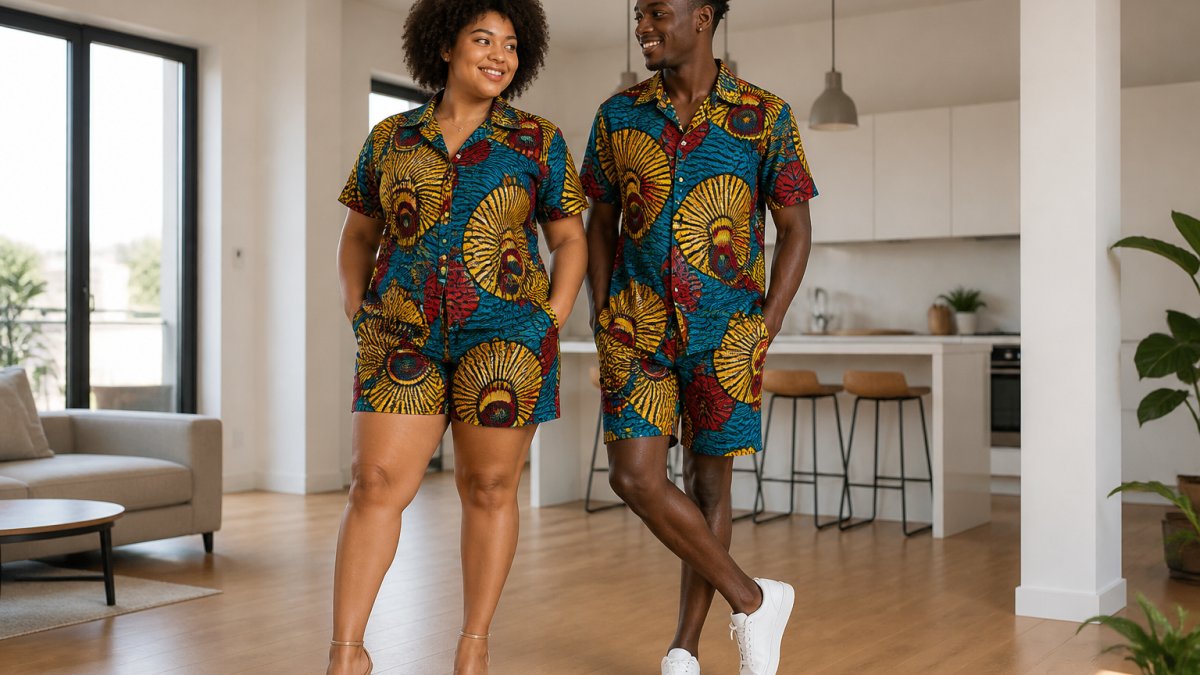
Gender-neutral outfits work best when you style around one statement piece and keep the rest quiet. A bold Ankara print does the talking; the supporting pieces should not compete.
Unisex Ankara Crepe Two-Piece Set →
Three styling approaches that hold up:
- Co-ord as a full look. Wear the matching set together, then break it apart: the jacket works with black jeans, the trousers with a plain tee.
- One print, neutral base. Pair a printed trouser with a fitted black top so the print carries the outfit.
- Layer for versatility. A unisex bomber over a plain base takes the look from home to social without a change.
The trade-off is real. Gender-neutral pieces are less precise in fit than tailored clothing, and a bold print is harder to wear to a formal office than a plain shirt. If you need boardroom polish, traditional tailoring still wins.
A decision framework for choosing between the two
Most shoppers do not need to pick a side. The useful question is which system suits the garment and the occasion. Work through these questions before you buy:
- What is the occasion? Formal, client-facing or dress-code-led settings usually reward traditional tailoring. Everyday, creative and social settings usually reward gender-neutral adjustability.
- How precise does the fit need to be? If the garment must sit a specific way on a specific body, a gendered block is the safer starting point. If you want one piece to work across more bodies and styling contexts, a shared block is more practical.
- What does the size chart actually say? Look for measurements in centimetres, a stated size range and construction details such as elasticated waists or dropped shoulders.
- How many outfits will it support? A gender-neutral piece that breaks into three or four looks earns its place; a statement piece that only works one way is a narrower buy.
- What is the care burden? Printed Ankara and crepe need hand washing or a cold machine wash and no tumble drying, or the print will fade. Factor that into how often you will actually wear it.
The trade-offs worth knowing before you buy
- Availability. Shared-size ranges are often narrower than traditional men's or women's ranges, so the extremes of the size spectrum are less well served.
- Fit compromise. A shared block fits the middle of the range well and the edges less well.
- Cost per wear. A versatile gender-neutral piece can earn its place across more outfits, but only if the fit works for you.
- Occasion limits. Bold prints and relaxed cuts are harder to wear in formal settings than plain, shaped tailoring.
- Care and longevity. Print fading and crease retention affect how long a garment stays wearable; cold washing and no tumble drying protect the print but add effort.
For concrete styling examples, our edit of unisex Ankara co-ord sets shows how the same set reads differently depending on how you style it.
Gender-Neutral Fashion and Self-Expression
Gender-neutral fashion supports self-expression by removing the "men's section or women's section" decision before you even start shopping. That sounds small, but it changes what you consider wearing.
When a garment is not coded male or female, you choose it on cut, print and comfort.
The research supports the demand side. Kim in 2022 used text mining to examine consumer preferences around genderless fashion trends (study on genderless fashion trends).
Honest limitation: gender-neutral clothing is not a solution to representation on its own. Columbia's finding that gender-fluid products skew male-centric shows that design intent and design execution are different things.
What the Market Data Says About the Shift
The market data points to growth, but read the numbers carefully. Forecasts from Fortune Business Insights on the gender-neutral fashion market project the global gender-neutral fashion market growing from $26.53 billion in 2026 to $54.12 billion by 2034, at a compound annual growth rate of 9.32%. Those figures are in US dollars and are forecasts, not audited sales.
What the data does not tell us: whether gender-neutral garments actually fit better, or whether consumers stick with them long term. Those questions need wardrobe-level evidence that the forecasts do not provide.
Choosing Your First Gender-Neutral Pieces at Afroleisurewear
Start with one versatile piece, not a full wardrobe. The lowest-risk entry is a trouser, because it pairs with what you already own and the fit is adjustable.
Our Unisex Ankara Pant with Pockets at £24.99 uses a relaxed elasticated and drawstring waistband with side pockets, in a black, teal and white geometric print.

For a statement layer, the unisex Ankara bomber jacket at £14.99 is a yellow and black Kente-inspired zip-up with side zip pockets and ribbed collar and cuffs.

Watch out: check the actual measurements before ordering, do not assume your usual size.
Frequently Asked Questions
What is the difference between gender-neutral fashion and traditional clothing?
Traditional clothing is usually cut to a gendered pattern: menswear follows shoulder and chest measurements, womenswear follows bust, waist and hip curves. Gender neutral fashion works from a single relaxed block that skips those shaped darts and narrowed waists. The result is a looser silhouette that relies on drape, print and layering rather than body contouring. In practice the biggest visible differences show up in fit, sizing labels and how much tailoring you need to make a piece sit right.
Is gender-neutral fashion the same as unisex clothing?
They overlap but are not identical. Unisex clothing is a production term: one garment, one size range, sold to everyone. Gender neutral fashion is broader and includes unisex pieces alongside clothing designed to avoid gendered signals in cut, colour or styling. A unisex Ankara pant with an elasticated drawstring waist is both. A flowy oversized shirt sold in one size is unisex in practice. The label matters less than whether the fit and sizing actually work across body types.
Does gender-neutral clothing suit every body type?
Not automatically. A relaxed block removes shaped darts, which means the garment has to work harder to sit well on different frames. Shorter wearers often find wide-leg trousers pool at the ankle, and broader shoulders can pull a dropped sleeve out of line. Check the actual measurements rather than the size label, and look for adjustable features such as drawstring waists and side slits. Try before committing where returns allow.
How do you style a gender-neutral outfit for work or everyday wear?
Build around one statement piece and keep the rest plain. A printed Ankara bomber jacket over black trousers and a plain tee reads sharp enough for a casual office. A monochrome patchwork Ankara pant with a crisp shirt and loafers works for evening. Keep the palette to two or three colours so the print carries the look. For lounging, a crepe co-ord set needs nothing more than trainers. The trade-off is that bold prints limit how often you can repeat the same outfit to the same crowd.
Is gender-neutral fashion a trend or a lasting change?
The commercial numbers point to a lasting shift rather than a short cycle.
The real challenge is not finding gender-neutral clothing. It is finding pieces that hold their print, fit across body types and work beyond one occasion. Afroleisurewear cuts unisex Ankara co-ords, trousers and bombers from a shared block, sizes them inclusively, and prices them from £14.99 to £29.99 with free delivery on orders over £60. Get started with Afroleisurewear and build a wardrobe that carries your heritage into everyday wear.

0 comments