

Last Updated: November 1, 2026
Quick Summary
The five sustainable alternatives to fast fashion brands are second-hand clothing, evidence-led sustainable brands, ethical brands with traceable supply chains, repair and care, and rental, swaps and donation. Start with second-hand, which costs nothing new to manufacture, then use evidence-led brands for the pieces you wear hardest.
- Second-hand clothing is the cheapest swap and needs no budget to start today.
- Ask a brand to name the fibre, country of manufacture and one certification in a single reply.
- Check GOTS, Fairtrade, OEKO-TEX Standard 100, GRS and B Corp certifications before buying.
- Test fair-wage claims by asking for a named factory and a published wage mechanism.
- Run every purchase through the five-question check and stop if you already own something that does the job.
Table of Contents
- Why Five Alternatives Beat One Guilt-Fuelled Purchase
- 1. Second-Hand Clothing: The Cheapest Swap You Can Make Today
- 2. Sustainable Clothing Brands That Publish Their Evidence
- 3. Ethical Clothing Brands: Fair Wages and Traceable Supply Chains
- 4. Repair, Mend and Care: Making What You Own Last Longer
- 5. Rental, Swaps and Donation: Circulating Clothes Instead of Buying
- How to Shop Sustainably for Clothes Without Losing Your Style
- Choosing Your First Ankara Piece from Afroleisurewear
- Frequently Asked Questions
Why Five Alternatives Beat One Guilt-Fuelled Purchase
Every year, millions of shoppers buy a fast fashion item, feel guilty, and buy another the following week. That cycle is the real problem.
There is no single heroic swap that fixes a wardrobe. What works is a mix of second-hand buying, evidence-led brands, repair, and circulation, each with a cost and a limitation.
Fast fashion is the business model of producing trend-led clothing quickly and cheaply, then replacing it within weeks. Sustainable fashion is clothing made and bought with lower environmental impact and fairer labour in mind, and it is a spectrum rather than a badge.
1. Second-Hand Clothing: The Cheapest Swap You Can Make Today
Second-hand clothing is the fastest, cheapest alternative available to most people right now, you can start this afternoon with no budget. Nothing new is manufactured, and your money often stays local.
The trade-offs are real: sizing is unpredictable, quality varies, and you need patience. A common mistake is hunting for a specific item rather than browsing for quality fabric and construction that happens to fit.
Charity Shops, Resale Apps and Car Boots Compared
| Channel | Typical Cost | Best For | Main Limitation |
|---|---|---|---|
| Charity shops | Lowest, often a few pounds | Browsing, one-off finds | Unpredictable stock and sizing |
| Resale apps | Low to mid | Specific sizes and labels | Postage, returns friction |
| Car boot sales | Very low | Bulk basics, weekend browsing | No returns, cash only |
| Swaps and giveaways | Free | Refreshing a wardrobe quickly | Fit is luck of the draw |
2. Sustainable Clothing Brands That Publish Their Evidence
The strongest signal a sustainable clothing brand can give you is evidence you can check without taking their word for it. Anyone can print a leaf on a label. Fewer can show you where the fibre came from and who made the garment.
Look for named certifications, published supplier lists, and specific fibre claims rather than vague "eco" language. Olivar Aponte and colleagues noted in their analysis of fast fashion's ecological impact (2024), the industry's environmental footprint is well documented, which makes transparency a reasonable thing to demand. Fan and colleagues also studied fast fashion consumer behaviour (2023) and found that shoppers' evaluations of these brands are shaped by what they can verify, not what they are told.
A useful rule: if a brand cannot tell you the fibre, the country of manufacture, and one certification in a single reply, treat the claim as marketing. For a closer look at African print pieces specifically, our guide to sustainable Ankara print clothing for women covers what verifiable claims look like in practice.
How to Compare Brands on Evidence, Price and UK Availability
Most shoppers need a shortlist, not a lecture. Use these four filters in order to narrow a long list of "sustainable" labels to a handful worth your money.
- Evidence filter. Can the brand name the fibre, the country of manufacture, and at least one third-party certification on its product page or in a single reply? If not, drop it.
- Price-band filter. Set a realistic ceiling before you browse. Ethical and certified garments usually cost more than fast-fashion equivalents, and that gap reflects the cost of verifiable materials and fairer labour. If a brand claims full certification but prices at fast-fashion levels, ask what is being left out.
- Availability filter. Check delivery options, returns policy and whether the brand sells through a UK high-street stockist or only direct online. A UK returns address is far easier to try than overseas shipping with no free returns.
- Sizing filter. Check the size range before you fall in love with a print. A brand offering XS-3XL with a published size guide is more useful than one offering S-L and vague measurements. If you are between sizes, ask for garment measurements rather than relying on the label.
For each shortlisted brand, note the fibre, certification, price band, size range and returns terms. Two or three brands compared this way will tell you more than twenty browser tabs.
Certifications Worth Checking Before You Buy
- GOTS for organic fibre content, from field to finished garment
- Fairtrade marks for producer and worker terms
- OEKO-TEX Standard 100 for restricted harmful substances (OEKO-TEX® STANDARD 100)
The Trade-Offs Nobody Mentions
Evidence-led brands are not automatically convenient. Stock levels are often lower, restocks slower, and limited-edition drops sell out. Delivery can take longer than next-day service, and sizing may run differently from high-street chains, so check the size guide and order one piece before committing.
Use evidence-led brands for the pieces you will wear hardest, trousers, jackets, basics, and fill gaps through the other alternatives in this guide. That mix keeps your budget realistic while shifting your money towards verifiable practice.
3. Ethical Clothing Brands: Fair Wages and Traceable Supply Chains
Ethical clothing brands can name their factories and explain how workers are paid. Traceability is the test: if the supply chain is a mystery, the ethics claim is a guess. But "fair wages" is one of the most abused phrases in fashion, so this section gives you a way to interrogate it.
Smaller producers who work directly with makers usually have shorter chains and clearer answers.
How to Test a Fair-Wage Claim in Practice
A fair-wage claim is only meaningful if you can trace it to a specific factory and a specific mechanism. Use these four checks:
- Named facility. Can the brand tell you the name and country of the factory that made the garment? A country alone is not traceability; a named facility is. If the answer is "our partners in India", ask again.
- Wage mechanism. Does the brand explain how wages are set, a published wage ladder, a collective bargaining agreement, or a third-party audit that includes wage data? "We pay fair wages" is a slogan; "we publish the wage floor at each supplier and audit against it" is a mechanism.
- Audit independence. Is the audit carried out by an independent body, or is it self-reported? Look for named audit standards rather than a generic "ethical audit" badge.
- Grievance route. Is there a published way for workers to raise concerns, and does the brand report on how those concerns are resolved? A brand that publishes remediation data is more credible than one that only publishes successes.
The Affordability Reality
Ethical production costs more, and that cost reaches the price tag. A garment from a brand that publishes factory wages and uses certified fibre usually costs more than a comparable fast-fashion basic, reflecting certified materials and wages that are actually checked.
The trade-off is real: you will buy fewer pieces. Treat ethical brands as a source for the garments you wear most, a coat, a pair of trousers, a jacket, and use second-hand, repair and swaps for everything else.
How to Spot Greenwashing in Three Minutes
Greenwashing is the practice of making a brand look more sustainable than its evidence supports. Three checks catch most of it:
- Vague words only. "Conscious" and "planet-friendly" with no fibre or certification named.
- No named factory. Ask which country and which facility. Silence is an answer.
- One green product line, no change elsewhere. A single "eco" range beside a fast-turnover core is a marketing exercise.
Watch out: a recycled-fibre claim says nothing about labour conditions, and a fair-wage claim says nothing about fibre. Judge each claim on its own.
Trade-Offs to Expect from Ethical Brands
Ethical brands are not a like-for-like swap for fast fashion. Lead times are longer, restocks slower, and size ranges can be narrower. Returns policies vary, and some brands charge for return postage. Check garment measurements rather than assuming your usual label. No brand is perfect: a strong labour story may sit alongside a limited fibre story, or vice versa.
A practical shortlist of two or three ethical brands, compared on named factory, wage mechanism, price band, size range and returns terms, will serve you better than a long list of vague recommendations. For a deeper list of ethical African fashion brands with traceable supply chains, see our dedicated guide. Combine it with the second-hand, repair and circulation options in this guide for a wardrobe strategy that is both affordable and defensible.
4. Repair, Mend and Care: Making What You Own Last Longer
Repair is the most underrated alternative, and it is almost free. A hem stitch, a button, a zip pull, and a patch add years to a garment. Learning three basic repairs costs less than one new item.
Care matters just as much. Our guides on how to wash Ankara fabric without fading and how to store premium African print garments cover the specifics for print fabrics. If you have already lost colour, this piece on African print cotton care mistakes explains what went wrong.
A local tailor or alteration service can handle anything beyond your skill level. That spend keeps a garment in use and out of textile waste.
5. Rental, Swaps and Donation: Circulating Clothes Instead of Buying
Circulation keeps garments moving between people instead of into landfill. Rental suits occasion wear you would rarely repeat. Swaps refresh a wardrobe at no cost. Donation passes items to someone who will wear them, provided they are in wearable condition.
The limitation is honesty about condition. Donating worn-out clothing is disposal dressed up as generosity. Sort first, pass on what is genuinely usable, and recycle the rest through a textile bank.
How to Shop Sustainably for Clothes Without Losing Your Style
Sustainable shopping is a decision order, not a personality type. Run every purchase through the same short sequence and your wardrobe improves without your style suffering.
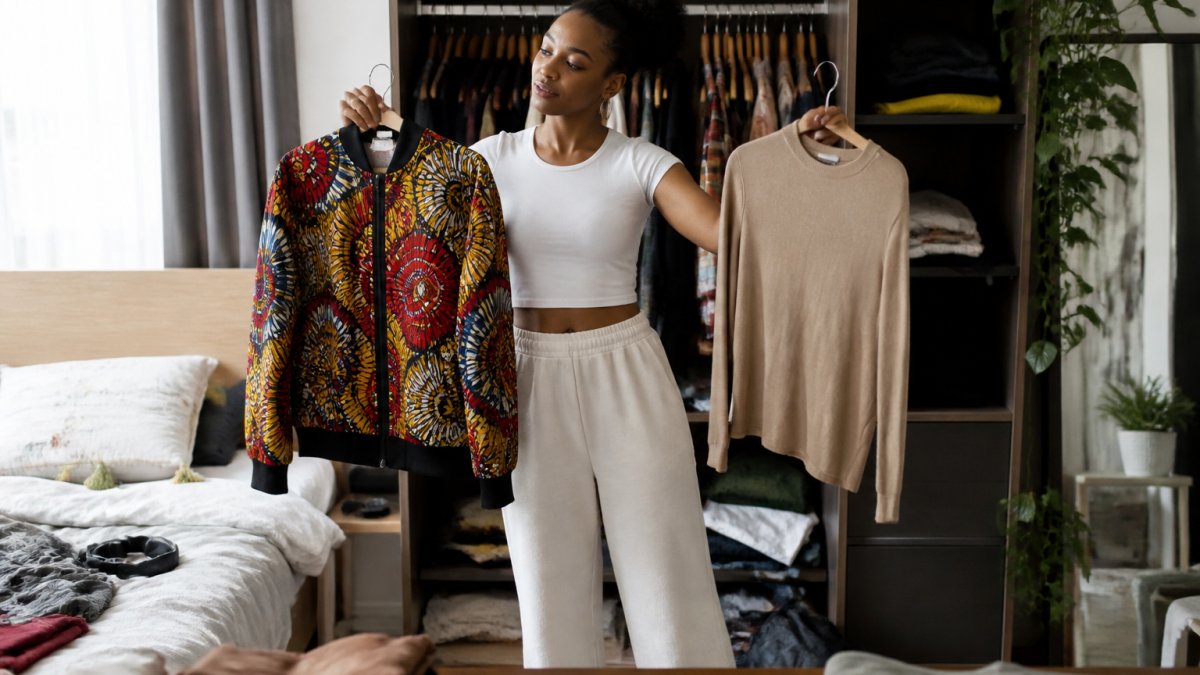
The five-question check before you buy:
- Do I already own something that does this job?
- Can I find it second-hand in my size within two weeks?
- Is the fabric and construction good enough for at least 30 wears?
If the answer to the first question is yes, stop. If the answer to the third is no, walk away regardless of price. Cost per wear beats sticker price every time.
Choosing Your First Ankara Piece from Afroleisurewear
The challenge with Ankara is confidence. Many people love the print but worry it will read as costume rather than clothing. Start with one piece in a relaxed silhouette and let the print do the talking.
At Afroleisurewear, we build everyday leisurewear around exactly that idea. Our Ankara Barrel Trousers (£41.99) use 100% premium cotton Ankara with a fully elasticated waist and sizes S to 3XL, so the fit is forgiving and the print carries the outfit. The Unisex Ankara Crepe Co-Ord Set (£29.99) gives you a matched jacket and wide-leg trousers in a unisex cut. For a lighter entry point, the African Print Bomber Jacket is £14.99.


One well-made print piece you wear constantly is a better wardrobe decision than five forgettable ones.
Frequently Asked Questions
What are the most realistic sustainable alternatives to fast fashion?
The five that work for most wardrobes are second-hand shopping (charity shops and resale apps), sustainable clothing brands that publish certification evidence, ethical clothing brands with traceable supply chains, repairing and caring for what you already own, and circulating clothes through rental, swaps or donation. Each has a different cost and effort level, so most people combine two or three rather than picking one. The aim is fewer, better-worn garments, not a perfect wardrobe overnight.
Is buying second-hand clothing actually more sustainable than buying new?
Usually yes, because the garment already exists. No new textile production, dyeing or shipping is triggered by your purchase, so the environmental cost has already been paid. The exception is buying second-hand items you never wear, or ordering single cheap items online with heavy delivery miles. Buy second-hand clothing you will genuinely wear, check seams and fabric weight before paying, and factor in repair costs. A repaired second-hand coat beats a new one on almost every measure.
How can I tell whether a brand is genuinely sustainable or just greenwashing?
Look for named, third-party certifications rather than vague claims like eco-friendly or conscious. Check whether the brand publishes supplier lists, factory names and audit results, and whether it explains what a specific material change actually achieves. Be wary of a single green collection sitting alongside hundreds of unchanged products. No fabric is completely sustainable, so treat any brand claiming otherwise with caution and compare like for like.
Do ethical clothing brands have to cost more than fast fashion?
Often yes at the point of purchase, because fair wages and lower-impact materials cost more to produce. The gap narrows when you calculate cost per wear. A £59.99 Ankara bomber jacket worn regularly for a long period works out at a low cost per wear. Buy less, choose pieces that suit several occasions, and the ethical option frequently wins on total spend.
How do I shop sustainably for clothes when I am on a tight budget?
Start with the free options: repair what you own, organise a clothing swap with friends, and shop charity shops in wealthier postcodes for better-quality donations. Set a rule of cost per wear before buying anything new, and prioritise pieces that work across at least three outfits. When buying new, look for size-inclusive brands with clear measurements and easy returns, so a single order replaces three failed ones. Free delivery thresholds, such as orders over £60, also cut the cost of buying well.
The real challenge is not finding alternatives; it is choosing one and starting this week. We would start with second-hand first, then add one piece you will genuinely wear for years. At Afroleisurewear, our Ankara leisurewear is designed for exactly that: size-inclusive fits, authentic African print, and limited-edition drops that stay in your wardrobe rather than the bin. Get started with Afroleisurewear and build a wardrobe you actually wear.

0 comments