

Last Updated: 10 November 2026
Quick Summary
The alternative to mass-produced digital African prints is small-batch, handmade African print clothing made from real cotton or cotton-blend fabric, with colour that holds through repeated washing and original design integrity rather than a traced copy. Buy from brands that disclose fabric composition, making location and print origin, and check certifications such as GOTS or OEKO-TEX behind any specific claim.
- Digital printing is cheaper and faster, while wax print is slower, more durable and carries higher minimum order quantities.
- Ask a supplier for a wash-test sample, because a digital print can pass a visual check and still fail after five washes.
- Spot ethical brands through disclosure: fabric composition, making country, real measurements, care instructions and credited designers.
- Small-batch Ankara runs are limited and not restocked, so fewer people wear the same print.
- Check certification logos against the certifying body's own public directory rather than trusting the product page image.
Table of Contents
- Why Mass-Produced Digital African Prints Fall Short
- High-Quality African Print Textiles: What Sets Them Apart
- Digital Printing Versus Wax Print: A Cost and Quality Breakdown
- How to Spot Ethical African Print Clothing Brands
- The Case for Small-Batch Ankara Clothing
- Building a Wardrobe with Ankara Pieces That Last
- Shop the Afroleisurewear Collection
- Frequently Asked Questions
Why Mass-Produced Digital African Prints Fall Short
The digital textile printing market was valued at roughly £2.1 billion at the end of 2025, according to Global Market Insights data cited by Maake. That growth has made authentic-looking African prints cheap and easy to produce at volume. At Afroleisurewear, we see the result on the high street constantly: bold patterns, low prices, and almost none of the craft that made the original designs worth wearing.
The problem is not that digital African prints exist. It is what happens when they are produced at industrial scale with no connection to the people or traditions behind the pattern.
The Hidden Costs of Fast Fashion Prints
Mass production pushes costs somewhere, even when the price tag hides it. Cheap digital African prints usually mean:
- Underpaid pattern designers whose work is copied or reproduced without credit
- Synthetic substitutes standing in for cotton Ankara to keep unit costs low
- Overproduction, with unsold stock adding to textile waste
- Compressed margins for small makers who cannot compete on volume
None of this shows up on a label. It shows up in how the garment feels after three washes, and in who got paid to make it.
What Gets Lost When Prints Go Digital
Digital printing is a genuine production method, not a villain. Sustainability News Africa reported in January 2026 that Epson showcased digital textile printing and recycling innovations aimed at helping manufacturers cut water use. That is real progress.
What gets lost is the hand. Wax print has a texture and slight irregularity that comes from the process itself. Digital replication flattens that into a perfect, repeatable image. The pattern survives; the character does not.
For a closer look at what handmade production preserves, read our guide on why choose handmade African print clothing.
High-Quality African Print Textiles: What Sets Them Apart
High-quality African print textiles are defined by three things: real cotton or cotton-blend fabric, colour that holds through repeated washing, and a print with genuine design integrity rather than a traced copy.
Here is how to tell the difference before you buy:
| Signal | High-Quality Print | Mass-Produced Print |
|---|---|---|
| Fabric | Medium-weight cotton, opaque | Thin, sometimes see-through |
| Colour | Deep, even, wash-resistant | Fades or bleeds early |
| Pattern | Considered, original design | Repeated stock motif |
| Finish | Clean seams, lined where needed | Loose threads, uneven hems |
| Price | Reflects real material cost | Suspiciously low |
Digital Printing Versus Wax Print: A Cost and Quality Breakdown
Digital printing versus wax print comes down to a simple trade-off: digital is cheaper and faster, wax print is slower and more durable. Neither is automatically better, but they are not interchangeable, and the difference shows up most clearly when you put numbers against each method rather than adjectives.
The cost side, per metre
For a small label buying in short runs, the headline price per metre is only part of the story. What matters is the all-in cost of getting a wearable garment out of the door.
- Digital pigment printing is usually quoted at the lower end per metre because it needs no screens, no wax and no washing-off stage. The catch is that short runs carry a setup charge, so the effective cost per metre falls sharply as run length rises. A 20-metre run and a 200-metre run are rarely priced on the same curve.
- Traditional wax print carries a higher per-metre price because the process involves waxing, dyeing, cracking and repeated passes. That price is more stable across run lengths, but minimum order quantities are typically much higher, often in the hundreds of metres, which ties up cash in stock a small label may not sell through.
A common pattern among independent designers is that digital wins on cash flow for a first collection, while wax print wins on margin per garment once a design has proven itself and can be bought at volume.
The quality side, over time
Watch out: a digital print can pass a visual check in the shop and still fail after five washes, so always ask a supplier for a wash-test sample before committing to a full run.
A simple decision framework
Use digital printing when you are testing a design, need a short run, or want a lower entry cost and can accept a shorter lifespan. Use wax print when the garment is a core piece, the design has proven demand, and you can fund a larger minimum order. Many small labels run both: digital for samples and limited drops, wax for the pieces they expect to restock.
A study in the Turkish Journal of Fashion Design and Management found that novel African-print fabrics could be produced without heavy machinery, which points to a middle path for small designers who cannot afford industrial setup.
If you are weighing whether the higher price is justified, our breakdown of whether premium Ankara clothing is worth it covers the maths.
How to Spot Ethical African Print Clothing Brands
Ethical African print clothing brands are identifiable by what they disclose, not by what they claim. Look for specific, checkable information rather than vague language about heritage.
The disclosure checklist
- Names the fabric and its composition, not just "cotton blend"
- States where the garment is made, down to the country
- Publishes real size measurements, not just S/M/L
- Shows the actual product, not only styled campaign shots
- Explains care instructions that match the fabric
- Has a clear, findable returns policy
- Credits designers or explains the print's origin
- Prices consistently with the stated materials
Two or three of these are easy to fake. All eight together are not. If a brand is vague on fabric and sizing but loud on heritage, that is the signal.
The certifications worth checking
The checklist above tells you whether a brand is being open. Certifications tell you whether an independent body has verified a specific claim. The ones most relevant to African print clothing are:
- GOTS (Global Organic Textile Standard), verifies organic fibre content and covers processing and social criteria across the supply chain. If a brand claims organic cotton, this is the standard to look for.
- OEKO-TEX Standard 100, tests finished textiles for harmful substances. Useful for confirming that a print or dye is safe against the skin, particularly for childrenswear.
- Fairtrade Mark, the familiar certification for fair terms and pricing for producers. Relevant where cotton or making is sourced from smallholder or cooperative supply chains.
- B Corp certification, a whole-company assessment covering governance, workers, community and environment. It does not certify a specific fabric, but it does indicate a brand has been independently assessed on its overall conduct.
- Textiles 2030, the UK voluntary agreement coordinated by WRAP, which commits signatories to reducing the environmental impact of textiles. A brand signed up to it has made public, measurable commitments on waste and circularity.
A brand does not need every one of these. But if it makes a specific claim, organic, safe, fair, low-impact, there should be a certification behind it, and the certificate number or licence should be findable on request.
Watch out: certification logos are easy to copy onto a website, so check the brand against the certifying body's own public directory rather than trusting the image on the product page.
What to ask before you buy
If a brand publishes none of the above, a short email is a fair test. Ask three questions: what is the fabric composition and where was it woven; where was the garment cut and sewn; and which certifications, if any, apply. A brand that answers clearly and quickly is usually one that has nothing to hide. A brand that replies with heritage language and no specifics has told you what you need to know.
UNESCO's 2023 report on the African fashion sector examined growth opportunities in the sector and highlighted how much of its value sits with the makers themselves. Transparency is how buyers protect that value.
For a starting shortlist, see our roundup of ethical African fashion brands.
The Case for Small-Batch Ankara Clothing
Small-batch Ankara clothing is produced in limited runs, so designs are not everywhere at once. When a print sells out, it is not restocked.
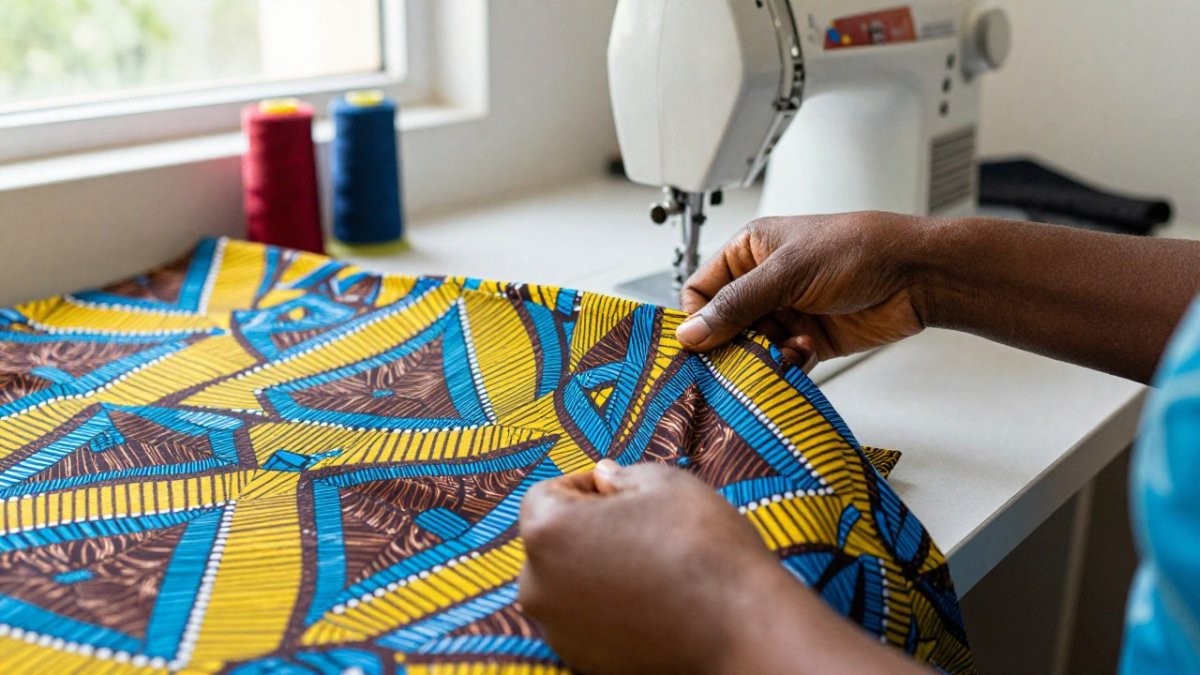
That scarcity is the point. Limited drops mean fewer people wear the same print.
The Ankara Barrel Trousers are made from 100% premium cotton Ankara in sizes S to 3XL, with an elasticated waist and a relaxed barrel leg, at £41.99.

If sustainable small-batch Ankara is your priority, our sustainable Ankara print clothing guide goes further into fabric and production choices.
Building a Wardrobe with Ankara Pieces That Last
A wardrobe built on mass-produced digital African prints needs replacing every season. One built on quality pieces does not. The trick is buying fewer things that work harder.
Start with separates that mix into what you already own. A bomber jacket in a bold Ankara print pairs with plain jeans or tailored trousers and carries an outfit on its own. The ASK Ankara Unisex Bomber Jacket is a relaxed, lined Ankara bomber jacket at £59.99.

For a complete look, the Unisex Ankara Crepe Co-Ord Set pairs a jacket with wide-leg trousers in a patchwork print, at £29.99. Wear it together or split it across outfits.

Shop the Afroleisurewear Collection
The alternative to mass-produced digital African prints is not a compromise. It is better fabric, honest sizing, and prints that are not on every rail in the country.
Our pieces are size-inclusive and unisex, priced from £5 to £50, with free UK delivery on orders over £60. Drops are limited.
The gap between a cheap print and a considered one shows up in the wash, not the shop. If you want Ankara that holds its colour and its shape, start with a small run and buy once. Browse the Unisex Ankara Crepe Co-Ord Set and see what small-batch production looks like in practice. Get started with Afroleisurewear and wear African print that lasts beyond a season.
Frequently Asked Questions
What are alternatives to mass-produced digital African prints?
Alternatives include small-batch Ankara clothing, hand-printed wax prints, and ethically sourced textiles from brands that prioritise artisan craftsmanship. Look for fabrics with slight irregularities that indicate hand-printing, and choose brands that disclose their supply chain. These alternatives often cost more but support local artisans and reduce the environmental impact of fast fashion.
How can you tell whether an African print fabric is hand-printed or digitally printed?
Hand-printed wax prints often show slight variations in pattern alignment and colour intensity, while digital African prints are perfectly uniform. Check the fabric's reverse side: hand-printed wax has a similar pattern showing through, whereas digital prints may appear white or faded. Also feel the fabric; traditional wax prints are typically stiffer and heavier than digitally printed cottons.
Are small-batch African print fabrics more sustainable?
Sustainability depends on dye practices and transport, so look for brands that disclose how they dye and source their fabric.
What is the difference between Ankara and wax print fabric?
Ankara is the West African name for wax-printed cotton fabric, which originated with Dutch wax prints. Wax prints are made using a resist-dyeing technique that creates distinctive crackle patterns. Digital African prints mimic these designs but are printed directly onto fabric, often lacking the texture and depth of traditional wax prints. High-quality African print textiles typically use wax or hand-dyed methods.
Where can I find African print clothing made in small batches?
Afroleisurewear offers small-batch Ankara clothing, including the African Luxe Ankara & Aso Oke panel Maxi Dress (£25.00) and the Unisex Ankara Crepe Co-Ord Set (£29.99). These pieces are limited-edition, so check the website for new drops.

0 comments